Po Boonak (पो बूणक, Po Būṇak) is the second of the four currents of Kopokhojaa. Its colloquial form is Po Boon. After Siddha Dharma was founded the Siddhas renamed it Soma Dharma.
The word Po means the pitṛs, the ancestors.
Section 01
What this current was
Po Boonak was the current of the ancestors, and for its people the pitṛs were the most important thing there was. Not one concern among several, weighed against the others. The most important thing of all.
Its central claim is a single identification, held from the depths of the antaḥkaraṇa rather than learnt as a doctrine: all the gods and goddesses that exist are our own pitṛs, and we are their descendants. The relationship here is descent itself, actual descent, and not some resemblance to it.
The rest of the system is that claim worked outward. Ishwar is the very first pitṛ, the first ancestor, and from him everything was born in its right sequence, the order running from the formless Brahman, then Yogmaya, then the forms of the Trimurti which are his forms with form, and then the gods and goddesses, and onward down to the very people praying. What another tradition would set out as cosmology, Po Boonak lived as genealogy. There is a line, it is unbroken, and you are standing on the near end of it.
They also held that we are here because we were sent: that on account of our own unworthiness, our sins, our unfitness, we were placed into this world by the ancestors whose descendants we are.
The practice matched the belief exactly. Their lifestyle is described as absorbed in it, always singing the praises of their pitṛs, remaining occupied in their worship, keeping themselves busy with it, and giving to them besides, offerings, gifts, prasād. And their kula gurus connected themselves with the ancestors through samādhi, the same trance state the other currents used, entered here to reach the pitṛs.
Section 02
Its major philosophies
Po Boonak takes its name from the word for ancestor, and everything it thinks runs along a line of descent.
Descent is the structure of reality. If Ishwar is the first ancestor, then the relation between God and the world is genealogical rather than legal or contractual. Creation is a line rather than an act performed on the world from outside, and every existing thing has a position on it.
The divine here is kin, and the asking takes its tone from that. One has only to listen to how these people asked for things. They asked their pitṛs the way a child asks its parents, with what the tradition calls a sense of belongingness, meaning with entitlement, as of right. Remove our sorrows. Take away this trouble. Give us joys. Take away our disease. Give us abundance. Give us progress. No supplicant approaches a sovereign in that register. It is how family talks.
Which is a philosophical position and not merely a mood, for if the gods are your ancestors, then petition is not presumption, and you are owed the hearing.
Mediation is built into this cosmos rather than added to it. The ancestors hold both divine and human qualities, and so they occupy the space between Ishwar and humanity by their very nature. No intercessor has to be appointed, because the structure of descent already supplies one at every level.
Karma, likewise, explains placement rather than punishment by a stranger. We were sent here on account of our own unworthiness, by beings who are our own, and so this world is a consequence rather than an exile imposed by someone with no relation to us.
The line is what the relationship runs on. If the deities at the head of it are the ancestors, then the bond with them is a live connection kept up by the giving and the asking, and reached through the kula guru in samādhi, rather than a memory of people who are gone.
Section 03
Its beliefs and articles of faith
The convictions Po Boonak lived on:
- Nothing whatever matters more than the pitṛs.
- All the gods and goddesses are our own ancestors, and we are their descendants.
- Ishwar is the very first pitṛ, and from him everything came in its right sequence, through the formless Brahman, Yogmaya, the forms of the Trimurti, and the gods and goddesses.
- We were sent into this world on account of our own unworthiness and our own sins.
- Giving is part of the relationship, and the ancestors receive it: offerings, prasād, gifts.
- One may ask of them as of one's own parents, with entitlement rather than with pleading.
- The kula guru in samādhi connects with the pitṛs and brings their guidance back.
- A life could rightly be spent absorbed in this, singing their praises and occupied in their worship.
- God is both with form and without form, and avatars are real. Po Boonak held this alongside Ko Boonak.
- A man's name carried his current. Mahasiddha Lal Nath, under this one, answered to Mahasiddha Lal Po.
Section 04
Its symbol
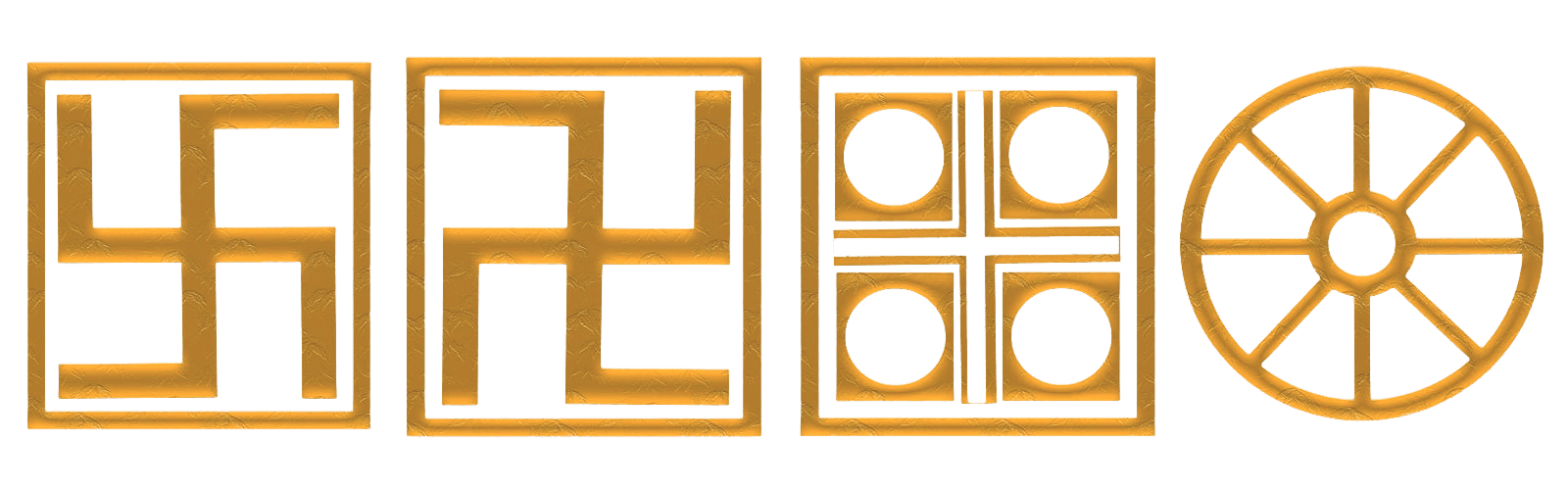
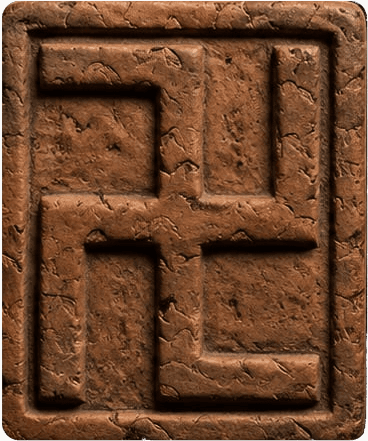
The reversed swastika.
Po Boonak's mark stands in a deliberate pair with Ko Boonak's swastika. Because Ko held one orientation and Po the other, this tradition possessed the swastika in both directions, right and left, from the beginning.
Ko Boonak's mark gave that current the Sanskrit name the Siddhas later applied to it, Swasti Dharma. Po Boonak's later name, Soma Dharma, does not come from its mark. What the reversal itself meant to Po Boonak the tradition has not set down publicly, so this page leaves it unsaid. What is on record is the pairing, and that both orientations belonged here from the start.
Section 05
The gods and goddesses of Po Boonak
Reserved for a future entry from the tradition's record.
Section 06
What Po Boonak looks like from here
Ancestor worship is the part of a tradition that outsiders most reliably patronise. It arrives pre-labelled as folk religion, the old village layer underneath the real theology, something a tradition grows out of once it develops proper metaphysics.
Po Boonak makes that label impossible to apply, because it does not put the ancestors in some lesser stratum beneath the gods. It says that the gods and goddesses are the ancestors, and that the line of descent runs unbroken from the person praying back through them to Ishwar himself, with no point along it where family stops and divinity starts. That is a theology, and a rigorous one, whose first premise happens to be kinship.
What follows is a religion with no stranger at the top. Most of what a person today has absorbed about God, from whatever direction, involves approaching a being who is fundamentally other, a sovereign, a judge, a creator standing outside what he made. Po Boonak neither begins there nor arrives there. It begins with your own people, extends the line upward, and finds God at the far end of it, still on the same line.
One can hear the difference in how they asked. The tone is the one a child uses with a parent, which the tradition names precisely as a sense of belongingness and entitlement. Take this trouble away. Give us abundance. Grovelling would have been strange between kin, and the right to ask was never in question.
Then there is what this current does with the past. A person today is generally handed two options for those who came before, that they are gone, or that they are somewhere else and out of reach. Po Boonak treats the line as live. Offerings go to the pitṛs and requests go to the pitṛs, and the kula guru could reach them in samādhi and bring back what they said. So a lifetime could be spent absorbed in this without it turning morbid, because the work was maintenance and not commemoration.
The piece most likely to be misread comes last. This current held that we are here because we were sent, on account of our own unworthiness, by our own people. Shame would seem the obvious result, and shame is not what it produced, because of who did the sending. Being placed somewhere difficult by a stranger is a sentence. Being placed there by your own family, who remain reachable, who can be asked, and who are expected to help, carries a different feeling altogether. The people of Po Boonak believed they were in a hard place, and believed they had not been abandoned in it.