
Section 01
The marks before the bull
Boona Kala was running before the bull came into it. What it did not have was a proper symbol of its own.
What held its people was the mountain. Any high snow mountain would do, and they bowed in front of it and said, you are god for us, because you give us water, you give us coolness, you give us a house to live in and a family to live in it with. So the mountain was everything, and on the mountain lived a deity whom they called Ishanak.
That name Ishanak was never one name. At that time different peoples and different tribes Ishanak by their own names, and each of those names is as much his as the next one. Every mountain was his dwelling. The dwelling of Ishanak, the dwelling of Shikhi Rudra.
Then the sun, the visible deity, the pratyaksha devata, whose miracle is there in front of everyone every single day. Without the Sun there are no seasons, no food, no life, no light and no heat, and we are finished. So the Sun is a deity for us.
And the moon, with the constellations behind it in the night sky.
Water and air are not on that list, and their absence is not an oversight. Water was not worshipped separately because the snow on the mountain was the water, so in worshipping the mountain they had already worshipped the water. Air was not worshipped separately because the wind blows across the mountain and was held to be inside it. The mountain was carrying all three.
The tree came later than the other three. When the Siddhas began working with herbs and with food, the tree entered the worship, and for the symbol they chose the tree most found on the high mountains, which is the deodar type. It does not follow that the tree of Boona Kala is the deodar. Different places and Siddhas there used different trees according to what grew where they lived, and any of those trees is the tree.
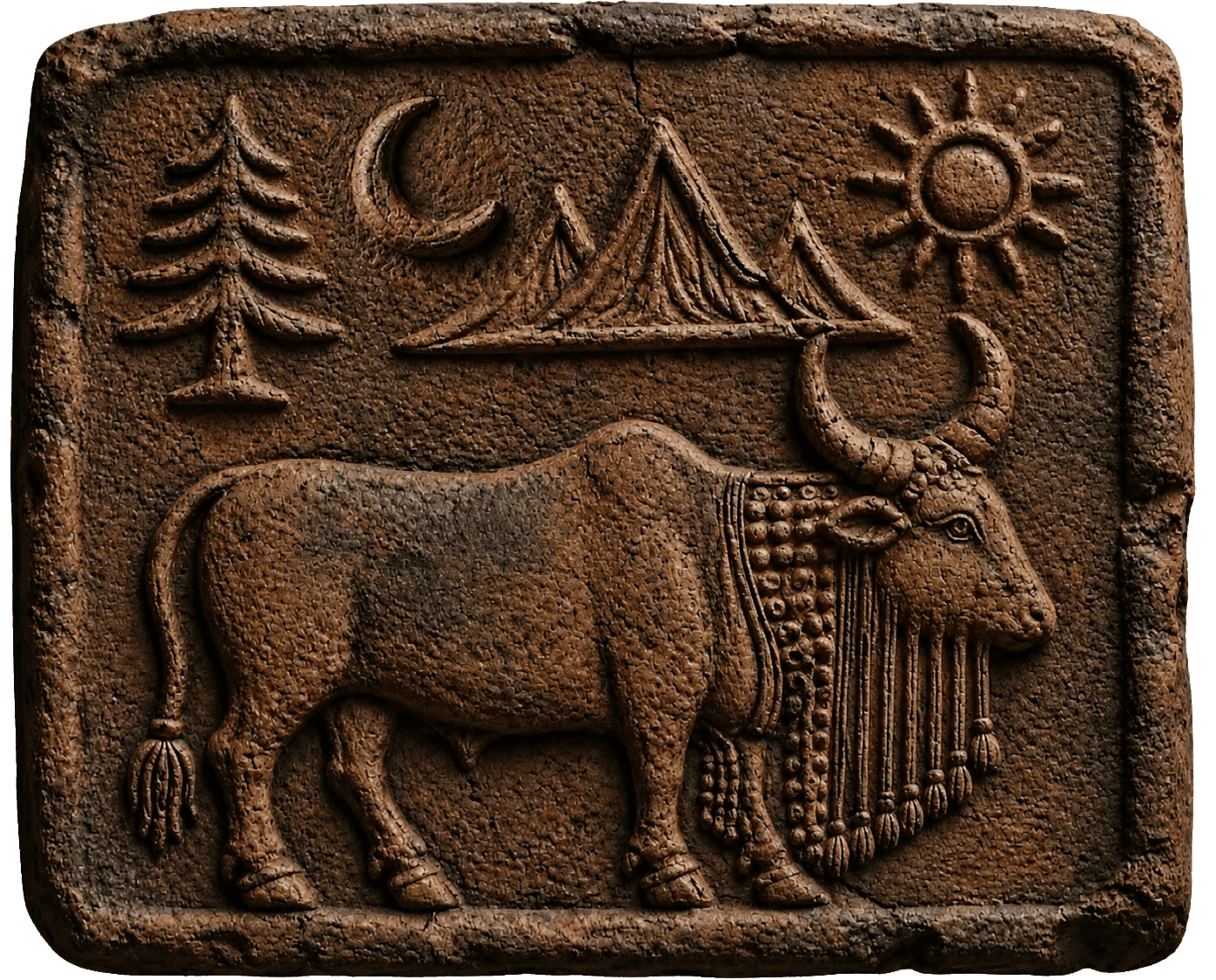
Four traditions grew up around these four marks: one whose mark was the mountain, one the sun, one the moon, one the tree. Later they came together and their four marks became one seal, and the mountain that had been single in it became three. That is the state of things when the Mahasiddha in the next section is born.
Section 02
Mahasiddha Gaṇa Śahaṇī गण शहणी
He belonged to the Booṇak tradition, in the period before there was any Kopokhojaa at all.
Some people are born unlike everyone around them. He was one such person. Three peculiarities were attached to him from birth, and the first was of thought: he could think in ways that nobody in his surroundings could think. The second was of the body. His skin tone was whitish, but whitish in some other way than the people around him were whitish. The pupils of his eyes were a strange colour, between blue and green, a little green and more of a blue, and his hair was different too. There was nobody like that for a long way in any direction. Not his parents. Not anybody.
So people looked at him and found him peculiar, vichitra, in their own midst.
The third peculiarity was a gift, and it was working from infancy, from the age. He could decipher what nature was doing. That this cloud has come and it will rain, and that one has come and it will not. That an animal is about to fall sick. That a man's signs say his death is likely within some days. These are small things in a village, and a child was saying them.
By the time he was six, seven, eight years old he had begun going into the forests and climbing to the top of a high mound. There he would put both hands up above his head and join them the way we join them in pranam in yoga, keeping his neck tilted a little back so his face was toward the sky, and he would pray. In the tradition's account the first mudrā of namaskar begins with him and with that gesture, hands joined above the head, and that only later did the joined hands come down from above to where we now hold them.
He touched the grass and talked with the grass. At a spring he spoke to the spring before he drank, and he never drank from a river or a spring without asking its permission first, and he did not let anyone else drink without asking either. He spoke to flowers before plucking them. He spoke to trees. He talked with the animals and the birds constantly, and they surrounded him on all sides, so that when he went into the forest even the birds that will not come near a human being came near him, and the creatures people are frightened of, snake and rat and chameleon, would climb up onto his body and sit there without any concern at all.
Nobody taught him. From childhood he did his own worship and his own sadhana, whatever the tradition of that time was, and he watched the people around him, and by fifteen or sixteen he was well known and respected among them.
Section 03
Become the Vrishabha
The people came to him and said: we want to accept you, we want to know you, and whatever you tell us we will do.
He said there was one rule to keep, that this rule was his first teaching for them, and that if they understood the qualities inside it they would begin to understand him. Then he did not explain the rule. He said, come with me, I am taking you up into the mountains.
Evening in the forest. They came to a place where the cattle had settled for the night, and they were not settled anyhow. The smallest calves were in the centre. Around them stood the cows. Around the cows the bigger calves, and on the outermost ring the big bulls, all of them facing out. And the largest bull was outside all of it, walking here and there, watching over his herd, coming into the circle sometimes and going back out of it, and whenever a wild animal tried to push in from one side, a bear or a tiger, he went to that side and drove at it with his horns.
Look at this vrisha bull, he said. Look at what he is doing. He is using his own strength for his family, his own people, his own surroundings, and he is using it to protect them.
So the first thing you have to learn from me is this. Become the Vrishabha.
This is where the Siddhas afterwards gave the name Vrishabha charitra, the character of the bull. Everyone wants to protect himself, and that is not the thing being pointed at. Vrishabha charitra begins at the point where a person is moved past his own protection into the protection of others, into parabhava, for his family, for his society, for his people.
The next day, higher up. Two groups of cattle grazing, and grazing brings them closer. The bull on this side calls out to the bull on that side, stay away. The other one calls back. But the cows keep grazing forward and the calves keep grazing forward, and the two herds arrive at the same place, and then the two bulls fight. They put everything they have into beating each other. And one bull's fortune does not stand with him. He goes over the edge of the mountain, and he dies as he falls, and the bull who put him there watches him go down from above.
He is fighting for his people. The courage is inside him first and the fighting comes out of it. From watching a bull like that comes the impulse in a man to fight for his people, for his idea, for his own truth, for his place, for his nation.
And notice what the bull thinks is his. He had a region and he fought for it. He fought for the ones living in it, and not only for them, because he counts that whole region as his own, its plants, its water, its things. That feeling has to come into us. Boona Kala taught it.
Out of the same scene comes the third quality, which is that you do not step back from the struggle. Whatever challenge comes in life, however large, you go at it with valour, without fear, with shaurya, and if the thing demands that you meet death, then you meet death.
Then the young bulls. In one herd there are many females and the calves keep coming, and among them bulls. The young bulls grow up and they do not like the old bull, the one who guarded that herd his whole life. They start attacking him. One of them cannot bring him down alone because he is still strong, so two of them come together to take the dominance for themselves, and between them they kill him.
Vrishabha charitra is in that too. This society, this creation, this world of ours is treacherous, and there is deceit in it. And even so you must keep struggling as long as there is breath in the body, because the day you leave off the struggle, death will come and carry you into the mouth of your own kaal.
And the plough. People kept the bull at home for ploughing. In that period the ploughing in the forest clearings was temporary and the plough itself was nowhere near what it later became, but people were ploughing. Picture a terraced hill field, a farmer working it since morning, his bulls yoked into the plough with him. The bulls are finished. Tears are coming from their eyes and foam from their mouths, and they are still going forward. The soil is stony. The ploughman is soaked through with sweat and just as tired as they are. Night has not closed in yet, so both of them keep putting their strength into it and both of them keep going forward.
He sat there and told the people: look at this man. He is doing this for his family, for his village, for the people around him. Now look at these Vrishabhas. They know who their master is, who gives them their grass, who keeps them, whose house they live in, and slowly they have become practised in hard labour exactly the way their master is. This Vrishabha is worthy of reverence. This Vrishabha has given us a new way of thinking. That is why I tell you to do Vrishabha pujan.
Section 04
Vrishabha Pujan
He was not telling them to worship the animal in front of them, and he said so plainly. Vrishabha pujan means the worship of those qualities and of that conduct which a bull in the forest teaches you. In this forest country, in this region, a bull teaches you these things, and it is those you are to hold in reverence. The practical bull is not the object. The bull is only the sign.
This is the beginning of pratika upasana, worship through a symbol. And with it begins the whole symbolism of Tantra, our reading of things and of animals and birds as carriers of meaning. Everything the tradition later does with symbols starts from a man pointing at a bull on a hillside and saying, that is not what I am asking you to bow to.
Section 05
The seal
When the Mahasiddha's philosophies came in, the older marks moved up and back, and the Vrishabha was established in the middle of Booṇa Kalaa.
The seal has stood that way ever since. Even now, when we do sadhana in the Himalayas or anywhere else at all, we will make a sun, we will make a moon, we will make three mountains and one tree, and we will make the Vrishabha, because the Vrishabha is the mark of dharma. The usefulness of the bull has fallen away and the world has changed past recognition, and the sign has run on from that time to this one without breaking. The symbols of Kopokhojaa are much later than these.
Once the Vrishabha was standing there, the philosophies began to be born out of it, one after another. What his two horns are, and what his tail is. What the four feet are. What the Vrishabha thinks, and what it is that the Vrishabha carries. Two or four of these have been given here and there are a great many more of them.
Booṇa Kalaa also keeps its sixes: six animals, six insects, six trees, and other sets of the same count, each of them with its own sign, each standing for one of the kalās of Booṇa Kalaa. The lists are not set out here.
It was a long time after all this before anybody called any of it a dharma. Booṇa Kalaa established itself slowly, and the name came very late.
Section 06
The first gurukula
When he began sitting in the villages to teach, the people wanted to please him, and what they did was to take the mud plaster on their walls and draw the Vrishabha on it and the rest of the marks with it, the way the seal is drawn. Then in front of that wall they raised a platform, a chabutara, and he sat there in front of the marks and gave his discourse.
We hold that to be the first gurukula of Boona Kala, and the beginning of the gurukula system of the Himalayan Siddhas.
Section 07
What became of the bull afterwards
The bull of Boona Kala is not Nandi. Nandi comes very much later, in a much later state of things, and the Vrishabha is older than him by a long way.
What happened is that when we began the upasana of Shakti alongside Shiva, the Kamadhenu cow came in beside the Vrishabha as the other half of a pair, and from there the Kamadhenu became famous in her own right. On this side the Vrishabha attached itself to Shiva as Nandi, and went on from there to Pashupati, and to Ishanak, and onward.